> ## Documentation Index
> Fetch the complete documentation index at: https://learn.social.plus/llms.txt
> Use this file to discover all available pages before exploring further.
# Content Sharing & Deep Links
> Generate shareable links for posts, communities, and user profiles to drive viral growth and cross-platform deep linking.
**SDK v7.x** · Last verified March 2026 · iOS · Android · Web · Flutter
```typescript theme={null}
// 1. Get share link configuration
const config = await Client.getShareableLinkConfiguration();
// 2. Build a share URL for a post
const shareUrl = `${config.baseUrl}/post/${postId}`;
// 3. Handle incoming deep link
// (deep link routing is app-layer responsibility — not part of the TS SDK)
handleDeepLink(incomingUrl, (resolved) => {
if (resolved.type === 'post') navigateToPost(resolved.postId);
if (resolved.type === 'community') navigateToCommunity(resolved.communityId);
});
```
Full walkthrough below ↓
**Platform note** — code samples below use TypeScript. Every method has an equivalent in the iOS (Swift), Android (Kotlin), and Flutter (Dart) SDKs — see the linked SDK reference in each step.
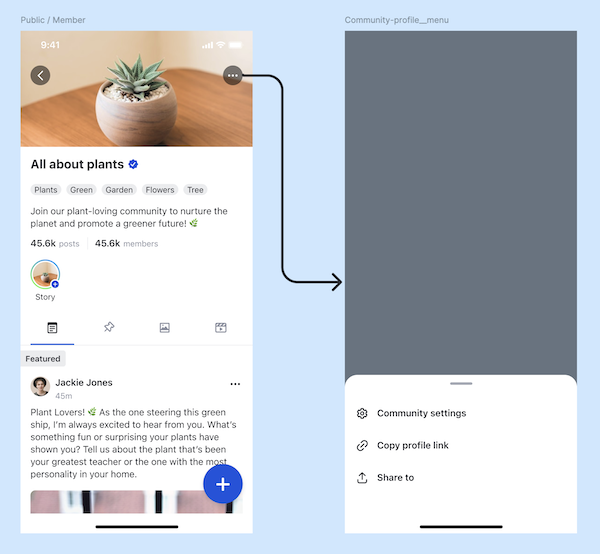
Shareable links turn your users into a growth engine. When a user shares a post or community to WhatsApp, Twitter, or SMS, the recipient can tap straight into your app. This guide covers generating share URLs from the SDK, configuring link patterns in the console, and handling incoming deep links.
```mermaid theme={null}
graph TD
A[User taps Share] --> B[SDK generates shareable URL]
B --> C{Share target}
C -->|WhatsApp/SMS/Email| D[Recipient receives link]
C -->|Social media| E[Link with preview card]
D --> F{App installed?}
E --> F
F -->|Yes| G[Open app → deep link to content]
F -->|No| H[Fallback to web/store]
G --> I[User views post/community/profile]
classDef action fill:#e1f5fe,stroke:#0288d1,color:#01579b
classDef decision fill:#fff8e1,stroke:#f9a825,color:#f57f17
classDef process fill:#f3e5f5,stroke:#7b1fa2,color:#4a148c
classDef outcome fill:#e8f5e9,stroke:#388e3c,color:#1b5e20
class A action
class C,F decision
class B,D,E,G,H process
class I outcome
```
**Prerequisites**: SDK installed and authenticated → [SDK Setup](/social-plus-sdk/getting-started/overview). Shareable links must be configured in **Admin Console → Settings → Shareable Links** (custom domain is optional).
**After completing this guide you'll have:**
* Shareable URLs generated for posts, communities, and user profiles
* Deep link routing that opens your app directly to the target content
* Share sheet integration for native OS sharing on iOS, Android, and Web
***
## Quick Start: Generate a Shareable Link
```typescript TypeScript theme={null}
import { Client } from '@amityco/ts-sdk';
const getPostShareLink = async (postId: string) => {
try {
const config = await Client.getShareableLinkConfiguration();
const { domain, patterns } = config;
const postLink = domain + patterns.post.replace('{postId}', postId);
return postLink;
} catch (error) {
console.error('Failed to generate share link:', error);
return null;
}
};
// Returns: "https://your-domain.com/posts/post-123"
```
Full reference → [Content Sharing](/social-plus-sdk/social/content-management/content-sharing)
**Shareable links vs. in-app reposts**: This guide covers *external* shareable links — URLs for WhatsApp, SMS, or social media that open your app via deep link. social.plus also has a distinct *in-app repost* mechanism: when a user reshares a post inside the app, the new post stores the original's ID in `sharedPostId` and increments `sharedCount` on the original post. Use shareable links for viral distribution outside the app; use the repost API for in-feed resharing within the app.
***
## Step-by-Step Implementation
The SDK fetches your configured domain and URL patterns from the server. Call this once and cache the result — it rarely changes.
```typescript TypeScript theme={null}
import { Client } from '@amityco/ts-sdk';
const config = await Client.getShareableLinkConfiguration();
// config.domain = "https://your-app.com"
// config.patterns.post = "/posts/{postId}"
// config.patterns.community = "/communities/{communityId}"
```
Full reference → [Content Sharing](/social-plus-sdk/social/content-management/content-sharing)
Use the pattern templates to construct URLs for posts, communities, and user profiles.
```typescript TypeScript theme={null}
const { domain, patterns } = config;
// Post link
const postLink = domain + patterns.post.replace('{postId}', postId);
// Community link
const communityLink = domain + patterns.community.replace('{communityId}', communityId);
// User profile link
const userLink = domain + patterns.user.replace('{userId}', userId);
```
Full reference → [Content Sharing](/social-plus-sdk/social/content-management/content-sharing)
Pass the generated URL to the platform's native share API. On web, use the Web Share API with a clipboard fallback.
```typescript TypeScript theme={null}
// Web Share API
if (navigator.share) {
await navigator.share({
title: post.data.text?.substring(0, 50),
url: postLink,
});
} else {
// Fallback: copy to clipboard
await navigator.clipboard.writeText(postLink);
showToast('Link copied!');
}
```
When your app opens from a shared link, parse the URL and navigate to the right screen. Match against the same patterns from the configuration.
```typescript TypeScript theme={null}
const handleDeepLink = (url: string) => {
const postMatch = url.match(/\/posts\/([^/]+)/);
if (postMatch) {
navigateToPost(postMatch[1]);
return;
}
const communityMatch = url.match(/\/communities\/([^/]+)/);
if (communityMatch) {
navigateToCommunity(communityMatch[1]);
return;
}
};
```
Set up your custom domain and URL patterns in **Admin Console → Settings → Shareable Links**:
* **Domain**: Your app's domain (e.g., `https://your-app.com`)
* **Post pattern**: `/posts/{postId}`
* **Community pattern**: `/communities/{communityId}`
* **User pattern**: `/users/{userId}`
These patterns are served to the SDK via `getShareableLinkConfiguration()`.
***
## Connect to Moderation & Analytics
 Track which posts and communities generate the most shares. Combine share events with impression data in **Admin Console → Analytics Dashboard** to measure viral coefficient.
Links to private community content should only work for authenticated users who are members. Visitors landing on a private community link should see a "Request to join" prompt, not the content.
If a shared post is later removed by moderators, the link should show a "Content unavailable" message rather than a 404. Handle this gracefully in your deep link handler.
***
## Common Mistakes
**Exposing internal object IDs in share URLs** — Use the SDK's shareable link configuration to generate safe, user-facing URLs instead of constructing them manually with raw IDs.
**Not testing deep links on all platforms** — iOS Universal Links, Android App Links, and web fallbacks all have different requirements. Test the full flow on each platform — especially the "app not installed" case.
**Skipping deep link verification** — Always validate the incoming deep link format before navigating. Malformed or tampered URLs should redirect to a safe fallback, not crash the app.
## Best Practices
* Add Open Graph meta tags to your web fallback pages so shared links show rich previews on social media
* Use UTM parameters on share links to track which channels drive the most installs
* Cache `getShareableLinkConfiguration()` at app startup — it only needs to refresh once per session
* Show a share count on posts to create social proof and encourage more sharing
* Always implement a web fallback for users who don't have the app installed
* Handle edge cases: deleted content, private content the user can't access, expired links
* Test deep links on both iOS Universal Links and Android App Links — each platform has different setup requirements
* Log failed deep link navigations to catch broken patterns early
* Pre-compose the share text with the post's first 50 characters + the link
* Show a "Copied!" toast when the clipboard fallback fires
* On mobile, use the native share sheet (iOS `UIActivityViewController`, Android `Intent.createChooser`) for the best experience
***
**Dive deeper**: [Posts API Reference](/social-plus-sdk/social/content-management/posts/overview) has full parameter tables, method signatures, and platform-specific details for every API used in this guide.
## Next Steps
Content is shareable — now track who's viewing it with impression analytics and reach metrics.
Or explore related guides:
Handle visitors who arrive via shared links
Build the feed that shared links navigate to
Create the communities that users share
Track which posts and communities generate the most shares. Combine share events with impression data in **Admin Console → Analytics Dashboard** to measure viral coefficient.
Links to private community content should only work for authenticated users who are members. Visitors landing on a private community link should see a "Request to join" prompt, not the content.
If a shared post is later removed by moderators, the link should show a "Content unavailable" message rather than a 404. Handle this gracefully in your deep link handler.
***
## Common Mistakes
**Exposing internal object IDs in share URLs** — Use the SDK's shareable link configuration to generate safe, user-facing URLs instead of constructing them manually with raw IDs.
**Not testing deep links on all platforms** — iOS Universal Links, Android App Links, and web fallbacks all have different requirements. Test the full flow on each platform — especially the "app not installed" case.
**Skipping deep link verification** — Always validate the incoming deep link format before navigating. Malformed or tampered URLs should redirect to a safe fallback, not crash the app.
## Best Practices
* Add Open Graph meta tags to your web fallback pages so shared links show rich previews on social media
* Use UTM parameters on share links to track which channels drive the most installs
* Cache `getShareableLinkConfiguration()` at app startup — it only needs to refresh once per session
* Show a share count on posts to create social proof and encourage more sharing
* Always implement a web fallback for users who don't have the app installed
* Handle edge cases: deleted content, private content the user can't access, expired links
* Test deep links on both iOS Universal Links and Android App Links — each platform has different setup requirements
* Log failed deep link navigations to catch broken patterns early
* Pre-compose the share text with the post's first 50 characters + the link
* Show a "Copied!" toast when the clipboard fallback fires
* On mobile, use the native share sheet (iOS `UIActivityViewController`, Android `Intent.createChooser`) for the best experience
***
**Dive deeper**: [Posts API Reference](/social-plus-sdk/social/content-management/posts/overview) has full parameter tables, method signatures, and platform-specific details for every API used in this guide.
## Next Steps
Content is shareable — now track who's viewing it with impression analytics and reach metrics.
Or explore related guides:
Handle visitors who arrive via shared links
Build the feed that shared links navigate to
Create the communities that users share